SEARCH
Enter your search term below:
Close 
Enter your search term below:
WORLD LEADING BUSINESS SUPPORT
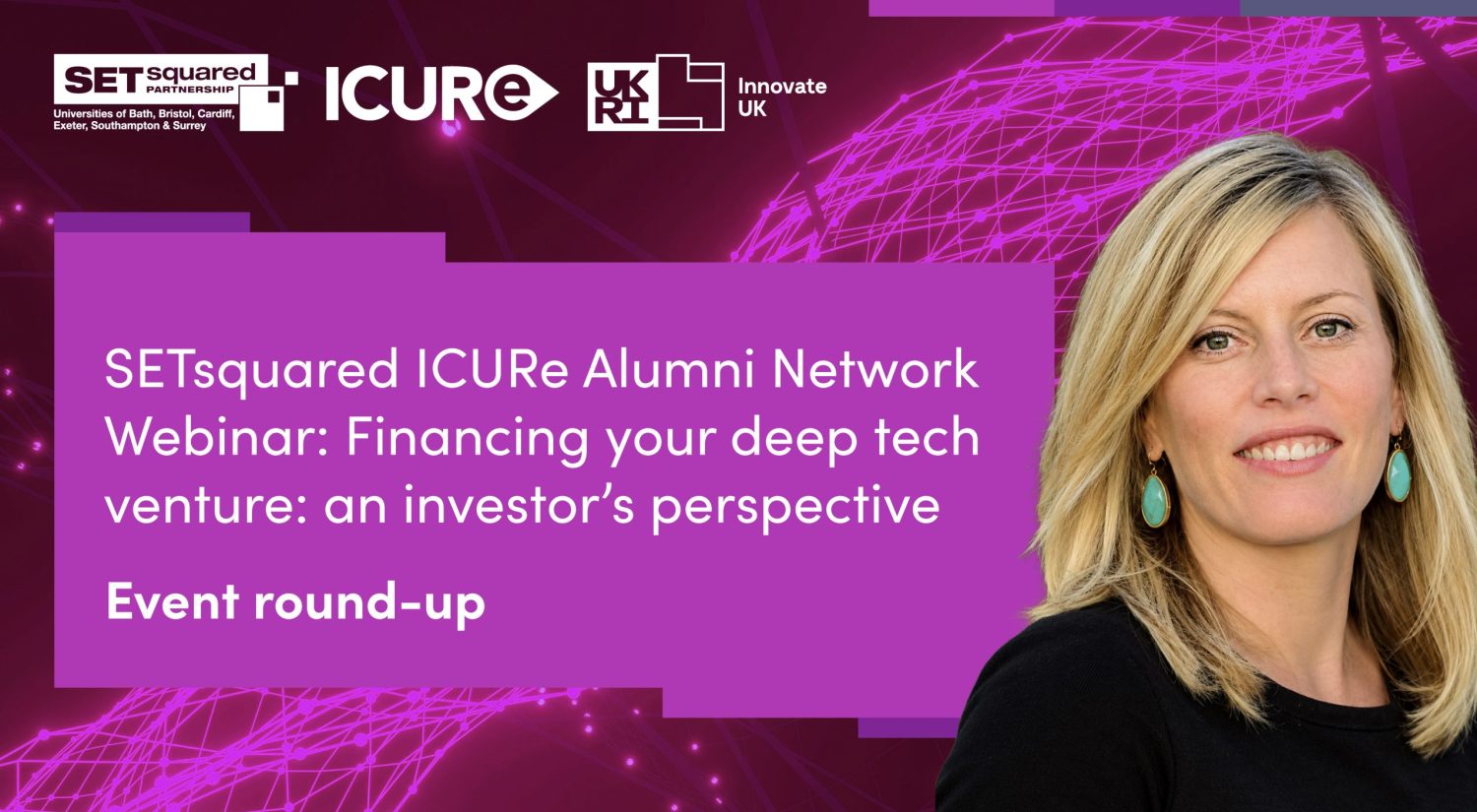
At the latest SETsquared ICURe Alumni Network webinar, Laurie shared a practical investor’s perspective on how founders can navigate the financing landscape and prepare for conversations with potential investors.
Drawing on her experience as an investor, founder and operator, Laurie explored how deep tech ventures can identify the right type and amount of capital, when to start building investor relationships and what founders can do to strengthen their investment case.
Beyond fundraising: think about financing
One of Laurie’s central messages was to think about financing, rather than simply fundraising.
The distinction matters. Financing should be viewed as a tool that helps a business move from where it is today towards a clearly defined destination. The first question, therefore, is whether external finance is actually needed.
For some software or consumer businesses, it may be possible to bootstrap and generate revenue along the way. For deep tech ventures, where significant capital may be needed before commercial revenues are possible, the equation can be different.
Where there is a gap between the company’s current position and where it needs to get to, external capital can help bridge that gap. But founders should start by considering what that financing will enable the business to achieve, rather than simply what the money will be spent on.
That means connecting capital to clear outcomes and milestones, while also thinking about the longer-term destination of the company.
Investors have a problem to solve too
Laurie encouraged founders to look at the investment process from the investor’s perspective.
For a founder, the business is a solution to a problem in the market. For an investor, the problem is how to deploy capital into opportunities where it can generate a return.
Investors have their own portfolios, criteria and decision-making processes. Founders therefore need to demonstrate not just that their technology is exciting, but why the business represents a credible investment opportunity.
That starts with credibility.
For Laurie, credibility comes from being transparent, honest about what has been learned and able to demonstrate evidence of execution. Early-stage companies will naturally have gaps, but acknowledging those gaps and showing how they will be addressed can be part of a strong investment case.
Customer discovery can strengthen the investment case
This is where the customer discovery work undertaken through ICURe can become particularly valuable.
During the Q&A, Laurie highlighted the importance of demonstrating that founders have genuinely tested their assumptions with potential customers.
Speaking to large numbers of customers does not automatically make a company investable, but it can provide evidence that the team has tested its proposition, explored routes to market and learned from the people it hopes will ultimately buy the product.
Those insights can also help founders communicate with investors more effectively.
Rather than relying on broad descriptions of the technology or market, founders can use the language and problems they have heard directly from customers to explain who the business serves and why the opportunity matters.
Investors don’t invest in dots; they invest in lines
Laurie’s advice on timing was equally practical.
As she put it during the session, “investors don’t invest in dots; we invest in lines.”
The point is that investors want to see progress over time. That means founders do not necessarily need to wait until they are actively raising before beginning to build relationships.
An investor may meet a company when it is too early for them. That does not have to be the end of the conversation. Founders can return with updates, explain what they have learned and show how the business has developed.
But relationship-building should be targeted.
Laurie encouraged founders to research investors carefully, looking at their portfolios, typical investment sizes and areas of interest. She also suggested that founders qualify potential angel investors by asking about their previous investments, how they find companies, how they make investment decisions and what their typical cheque size and process look like.
The aim is not simply to have more investor meetings. As Laurie noted, 500 meetings are of limited value if only a small proportion of those investors are relevant to the business.
Make the opportunity easy to understand
The discussion also explored the challenge of communicating businesses operating across areas such as impact, public sector markets, national security and dual-use technology.
Laurie’s advice was not to try to make a company relevant to everyone.
Instead, founders should be specific about who they sell to and what problem they solve, rather than relying too heavily on broad labels.
This can be particularly important for deep tech companies, where technical language can quickly become a barrier to understanding. Laurie encouraged founders to use straightforward language and, where possible, reflect the language customers themselves use.
She also encouraged founders to keep their investment story clear and accessible, using financial information to show how capital translates into growth and, ultimately, returns, while keeping deeper detail available when investors want to explore it.
Think beyond venture capital
Another major theme was that venture capital is only one part of the financing landscape.
Laurie highlighted more than 17 ways to finance a business, including revenue, prizes and grants, crowdfunding, recoverable grants, loans, venture debt and equity.
Different forms of capital come with different expectations and implications, from non-dilutive funding through to equity investment.
The most appropriate option depends on the business, its stage, its capital requirements and what it needs to achieve next.
For founders, understanding those options means they can consider financing as part of a wider strategy rather than assuming that raising equity is always the next step.
Think about the investor’s route to a return
Laurie also encouraged founders to think about how investors ultimately get their money back.
Venture funds commonly operate over a ten-year period, with potential extensions, so investors need to understand how capital can ultimately be returned within that timeframe. The timing can also depend on where an investor is within their own fund cycle.
For founders, this reinforces the importance of understanding who they are taking investment from and what that investor expects from the relationship.
It also means thinking about the longer-term route to value creation – whether through revenue, acquisition, IPO or another outcome – rather than viewing investment simply as money arriving in the business.
Build relationships before you need the money
The final message from the session was that investor relationships do not have to begin when a funding round opens.
Speaking to investors before a formal raise or even before a spin-out can help founders establish relationships and give investors the opportunity to see progress over time.
But Laurie also highlighted the opportunity cost. Raising investment can consume a significant amount of founder time, and that time could otherwise be spent on sales, customer development or reaching the next milestone.
Her suggestion was to treat investor outreach as an experiment: test the market for a defined period, see what response it generates and use that information to decide how to proceed.
For deep tech founders, that approach reflects the wider message of the session. Becoming investment-ready is not simply about perfecting a pitch. It is about understanding the business, the market, the financing options and the investors – and bringing those pieces together at the right point in the company’s journey.
Stay connected with the ICURe Alumni Network
The support doesn’t end with the webinar. ICURe alumni can continue to engage with the Network through local events, online meetups, podcasts, peer-to-peer recommendations and mentoring opportunities.
If you have an idea for an alumni activity, would like to get involved in mentoring, or want to hear more about opportunities across the Network, get in touch with the ICURe team at [email protected].
The Network also offers opportunities to connect with SETsquared programmes, cohorts and the wider innovation community.
Get all the fresh insights first! Stay up-to-date with all the
latest investment news, blogs and all things SETsquared.
Close
SETsquared is a partnership between


Close