SEARCH
Enter your search term below:
Close 
Enter your search term below:
WORLD LEADING BUSINESS SUPPORT
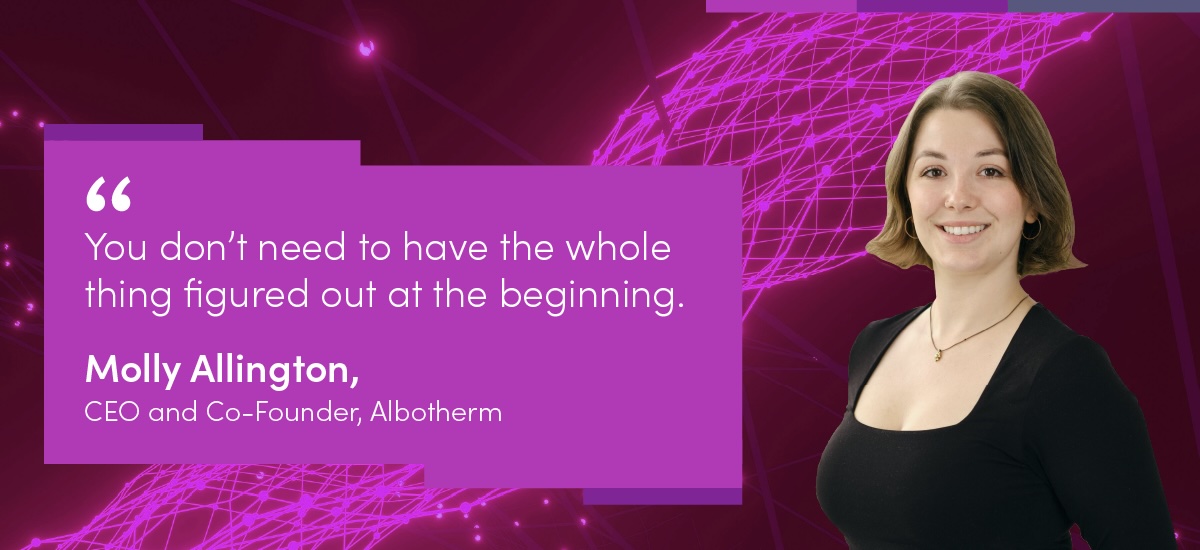
What began as a summer project during Molly’s chemistry degree grew into a commercialisation journey, with ICURe helping the team along the way. Through customer discovery, the greenhouse sector emerged as a promising market, where growers were facing a clear problem but relying on relatively low-tech solutions.
Since then, Albotherm has grown its team and raised over £1.5 million in investment, while Molly has developed from a chemistry degree into the commercial and market-facing side of the business.
How did you first become involved with the research behind Albotherm, and what made you see its potential?
“I first became involved in the research behind Albotherm while I was studying chemistry at the University of Bristol. One of my lecturers was working with a PhD student, Sian Fussell, who had developed an idea for using innovative materials to help cool greenhouses and conservatories.
“I initially joined Albotherm as part of a summer project. There was a clear problem to solve, but the materials behind it offered the potential to do something quite different. Sian and I eventually became co-founders, and we started looking more closely at where the technology could fit, who might need it and what a business built around it could look like.
“What began as a university project gradually became something much bigger, but the first challenge was understanding whether there was actually a market for the research and, if so, where that market might be.”
What did ICURe teach you about the potential market for the research?
“One of the most useful things ICURe gave us was the opportunity to step back and ask where this technology could actually have the greatest impact.
“We had already considered greenhouses, but we also explored applications in construction and solar panels. The solar panel idea was a bit of a wildcard, but that was a valuable part of the process – we weren’t just trying to prove that our first idea was right; we wanted to find out where there was a genuine need.
“The process of speaking to people and testing those ideas gave us a much clearer picture of where the strongest opportunity might be. By the end of the programme, the greenhouse industry had generated the most interest.
“That was an important lesson for us. You need to understand where the problem is being felt most strongly and where people are open to a different solution.”
How did ICURe help you develop the skills and confidence to take your research towards commercialisation?
“The ICURe Explore programme can sound like a dream when you first hear about it. You get to travel, meet people and investigate different markets. It is an incredibly valuable, but intense, experience.
“You’re constantly travelling, speaking to new people and trying to understand a business world that you haven’t necessarily had any formal training in. There were calls at some ridiculous hours depending on where we were – I remember joining calls at three in the morning.
It was mentally and physically demanding, but that was also what made it useful.
“Starting a company is about having to power through things you haven’t done before. There isn’t a neat playbook waiting for you. You often have to figure things out while you’re already doing them; it requires you to be more resilient than ever before.”
Can you give an overview of the trajectory you’ve taken with Albotherm since completing ICURe?
“Since completing ICURe, the journey with Albotherm has been about turning the initial market opportunity into a growing company.
“Our team is now ten-strong, which is exciting, but reaching that point has brought a completely different set of challenges. When you’re very small, everyone naturally knows what everyone else is doing. As you grow, you need more clarity. People need to understand what they’re responsible for, how their work fits into the wider picture and what you’re all trying to achieve.
“In the early stages, we could be much more hands-on and flexible, but as the team has expanded, we’ve had to balance the need for more structure while also not trying to plan every detail months in advance.
“It’s a much more agile approach, but I think it suits where we are as a business. There still needs to be structure – particularly when you’re reporting progress to investors and the wider team – but you also need enough flexibility to actually get things done.”
What have been some of the biggest challenges or barriers to overcome?
“One of the biggest personal challenges has been moving beyond my original area of expertise.
“My background is in chemistry, but within Albotherm I’ve worked more on the market-facing side of the business, while my co-founder has a more technical background. That meant I had to adapt quickly.
“I didn’t have formal training in those areas, so a lot of it has been learning on the job.
That’s still the case now. As the company grows, new challenges keep appearing and you find yourself needing skills that you didn’t necessarily expect to need when you started. You can’t wait until you feel completely qualified before taking on something new, because there will always be another area where you have more to learn.”
What traits and new skills have you had to develop as a co-founder?
“As a co-founder, I’ve really had to grow into the role as our team has expanded. I’ve had to build up my skills in people and project management – making sure everyone is clear on what they’re doing, how their work fits together, and what we’re all working towards, even when things are changing all the time.
“One of the biggest shifts has been learning how to create enough structure to keep the team, our board and our investors confident that we’re making progress, without over-engineering things. I’ve had to get comfortable with a more agile way of working – keeping communication clear and accepting that part of the job is making it feel a bit less chaotic for everyone while we still move quickly.”
How much investment and funding have you raised so far, and are there some broad lessons you can share on how you’ve successfully approached this?
“So far, we’ve raised around £1.5 million in investment, alongside a similar amount in grant funding.
“On the grant side, we’ve had a lot of success with Innovate UK funding, as well as funding through DEFRA’s (Department for Environment Food & Rural Affairs) Farming Innovation Pathways programme. One thing I’ve learned is that applying for grants is a skill in and of itself. It’s not simply about having a good project; you need to understand what the funder is looking for, explain why your work is relevant and present the company and project in a way that makes that clear. Specialist funding calls can be particularly valuable because there is already an understanding of the problem you’re trying to address.
“Our most recent fundraising journey felt like a bit of a whirlwind. We spent months speaking to investors and having conversations that seemed to be going well, but we weren’t quite managing to close the round. A major shift came when we started speaking to Green Angel Ventures and progressed into due diligence with them as a lead investor. Having that credible lead investor changed the dynamic.
“Looking back, I think part of our challenge was timing. We were trying to raise at a point that wasn’t quite right for where the business was. Sometimes it isn’t simply about finding the money – it’s about understanding when your business is ready for it.”
What one piece of advice would you give to ICURe alumni for the journey ahead?
“If I had one piece of advice for other ICURe alumni, it would be to build a really strong support network. You encounter so many different challenges when you’re building a company that having people you can call for advice makes a huge difference.
“Some of the people we met through ICURe are still part of our network today. Some have gone on to become investors themselves, and we’ve continued to speak to advisers from the programme. I’ve been struck by how willing people are to give their time and experience when they genuinely believe in what you’re trying to do.
“That’s one of the biggest things I’ve taken from the journey so far. Commercialisation isn’t a direct line from research to company – you explore different markets, learn skills you never expected to need, change how your team works and sometimes realise that the approach you thought would work simply doesn’t.
“You don’t need to have the whole thing figured out at the beginning. You need to keep asking questions, stay open to changing direction and make sure you have people around you who can help you work out what comes next.”
Get all the fresh insights first! Stay up-to-date with all the
latest investment news, blogs and all things SETsquared.
Close
SETsquared is a partnership between


Close