SEARCH
Enter your search term below:
Close 
Enter your search term below:
WORLD LEADING BUSINESS SUPPORT
You’ve had an interesting journey from Business Development to Commercialisation Lead – what prompted your transition into biomedical research, and then into leading the project?
Yes, I’ve done a full circle. I have a business degree, and I started in commercial roles, marketing and business development. I worked at Procter & Gamble and then at a major international law firm. I moved into science because I wanted to work on problems with bigger stakes than the ones I’d been solving. I retrained, starting with a BSc in Biomedical Sciences. During a PhD in Medicine, I made the discovery that became the innovation behind ShuttleVax.
For a long time, I thought of these as unrelated careers, kept in separate mental drawers. It was during ICURe Discover that I realised all my degrees and experiences could converge on the commercialisation work. That’s when I became properly invested. The translation layer between science and business turns out to be exactly where I want to work.
What initially motivated you to apply for ICURe, and what were you hoping to get out of it?
Honestly, it wasn’t my idea to start with. We had a patent and no idea what to do with it – the science was there, the route to market wasn’t. My PI suggested I look at ICURe. What I didn’t have at that point was any sense that this kind of support for academic founders even existed. As a postdoc, you know the grants landscape, but the whole scaffolding around spinning out – the accelerators, the market discovery programmes, funding and mentoring is invisible because there’s so little awareness of it among scientists.
Discover reframed how I thought about my research. I realised market validation was the crucial next step, so I was already set on getting onto an Explore cohort by the time it finished.
How did ICURe help you understand the commercial readiness of your technology? Did you change your approach afterwards?
Explore was the most transformative stage. The verdict on our commercial readiness was fairly brutal: our original concept, a colorectal cancer vaccine, was too early in development for a fast-moving investor market, where a 7-10-year wait for a return is an unacceptable risk. As a result of market validation, we pivoted twice. First, to a delivery platform we could license to vaccine developers and pharma. The second came from an ICURe challenge to find a ‘wild card’ application for the technology – that’s what took me down the veterinary route.
So we ended up with three separate workstreams.
What did you find were the main challenges during the programme – stepping out of your comfort zone, finding your market, pitching to investors – or something else entirely?
Keeping everything together during Explore. Flying around the world, jet lag after jet lag, weekly meetings before dawn followed by 10pm mentoring, notes, records, follow-ups, LinkedIn, planning the next trip while trying to memorise the backgrounds of the fifteen people I was meeting tomorrow. But it was great fun!
What was the most surprising thing you learned about yourself or your technology during the programme?
How much I got invested in the commercialisation journey, and how much I enjoy it. When I pivoted my whole career from business to science, I really thought I’d closed the previous chapter and that there was no returning to it. I also discovered I’m much better suited to running and building a venture than to a purely research role. ICURe rather spoiled my scientific future: there’s no going back to being a bench scientist now (joking – but it’s also true).
What happened immediately after ICURe – did you pivot, pursue funding? Have you been able to keep up the momentum?
Straight after Explore came Exploit, then the Cancer Tech Accelerator – Cancer Research UK’s oncology startup programme, which I completed over the summer. I also applied for the Royal Academy of Engineering Enterprise Fellowships. I didn’t get it (a good lesson in building the resilience this path demands), but I got through to the interview stage, and I learned a lot in the process. Both in preparation for the interview (it took me 3 solid weeks!) and from the feedback.
On funding, we’ve since won two UKRI Impact Acceleration Account grants – one from the MRC, one from the BBSRC – both off the back of ICURe, funding the de-risking work across the human and animal streams. We’ve also submitted a UKRI Proof of Concept application (result pending).
Did ICURe open any doors you didn’t anticipate?
The biggest door ICURe opened was the one in my own head. Before ICURe, my job was dependent on a PI securing funding. ICURe widened my perspective to commercialisation grants and awards, and to the many dilutive and non-dilutive funding schemes out there, not only in the UK but across Europe. That changed my role entirely; I’m now the one identifying and driving the funding opportunities. And even though the road is bumpy and sometimes disheartening, I really value the agency and independence that come with it.
You’re really active on LinkedIn and open about who you want to connect with – what are your aspirations for the future, and do you have a plan to get there?
Right now, I’m putting all my efforts into driving the venture, with incorporation planned for mid-2027. I have mapped out how we get there, with contingencies for most turns of events. But ultimately, while I can put in the time, effort, and perseverance, I can’t control the outcome, and the future is largely unknown. Which I consider to be the epitome of entrepreneurship – navigating volatility in uncharted waters.
LinkedIn helps build visibility and a network. I’ve also started documenting the academic founder journey. I believe UK research institutes generate brilliant science, but the path to commercialisation remains a hard one. If I can inspire a few researchers coming up behind me, all the better.
What message would you give to other researchers on your ICURe experience? Do you have any advice?
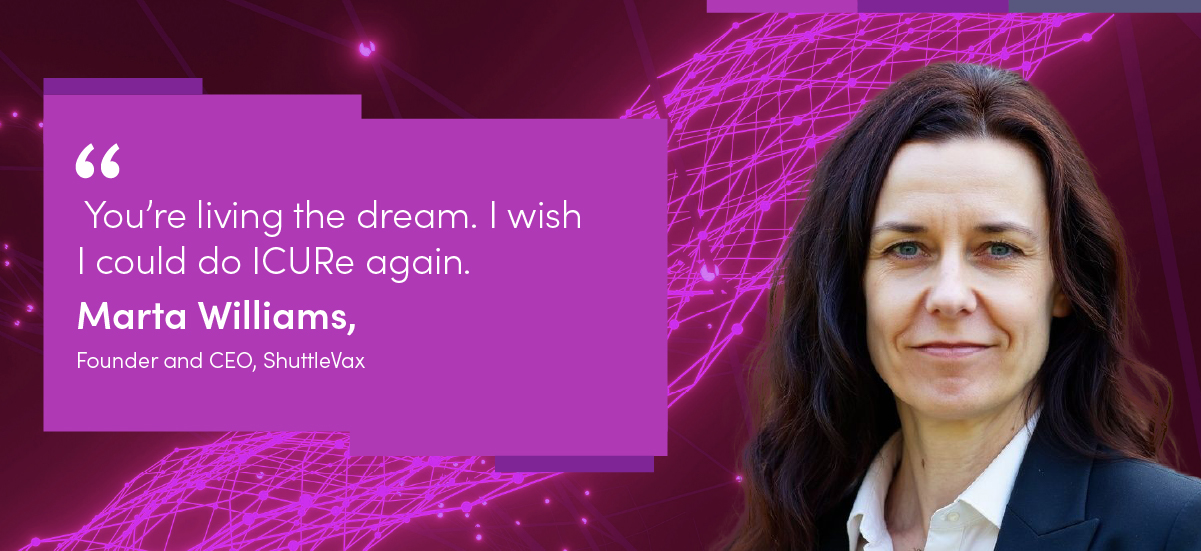
Having done the whole ICURe route, my advice is to engage with everything and maximise every opportunity. Explore and Exploit are very intensive, and it’s easy to feel inundated – nonstop sessions, daily homework, readings, admin and preparations – but it’s such a valuable time. Cherish it and use it to your best advantage. You are being paid to learn, to build new skills and to think outside the box. You are in a cohort of very inspiring co-founders, with access to mentors and coaches from fields you’ve never worked in, and you have time to read around those new subjects. And you are living a dream – a scientist working on a breakthrough technology, building a deep tech startup. I wish I could do ICURe again.
Connect with MartaGet all the fresh insights first! Stay up-to-date with all the
latest investment news, blogs and all things SETsquared.
Close
SETsquared is a partnership between



Close