SEARCH
Enter your search term below:
Close 
Enter your search term below:
WORLD LEADING BUSINESS SUPPORT
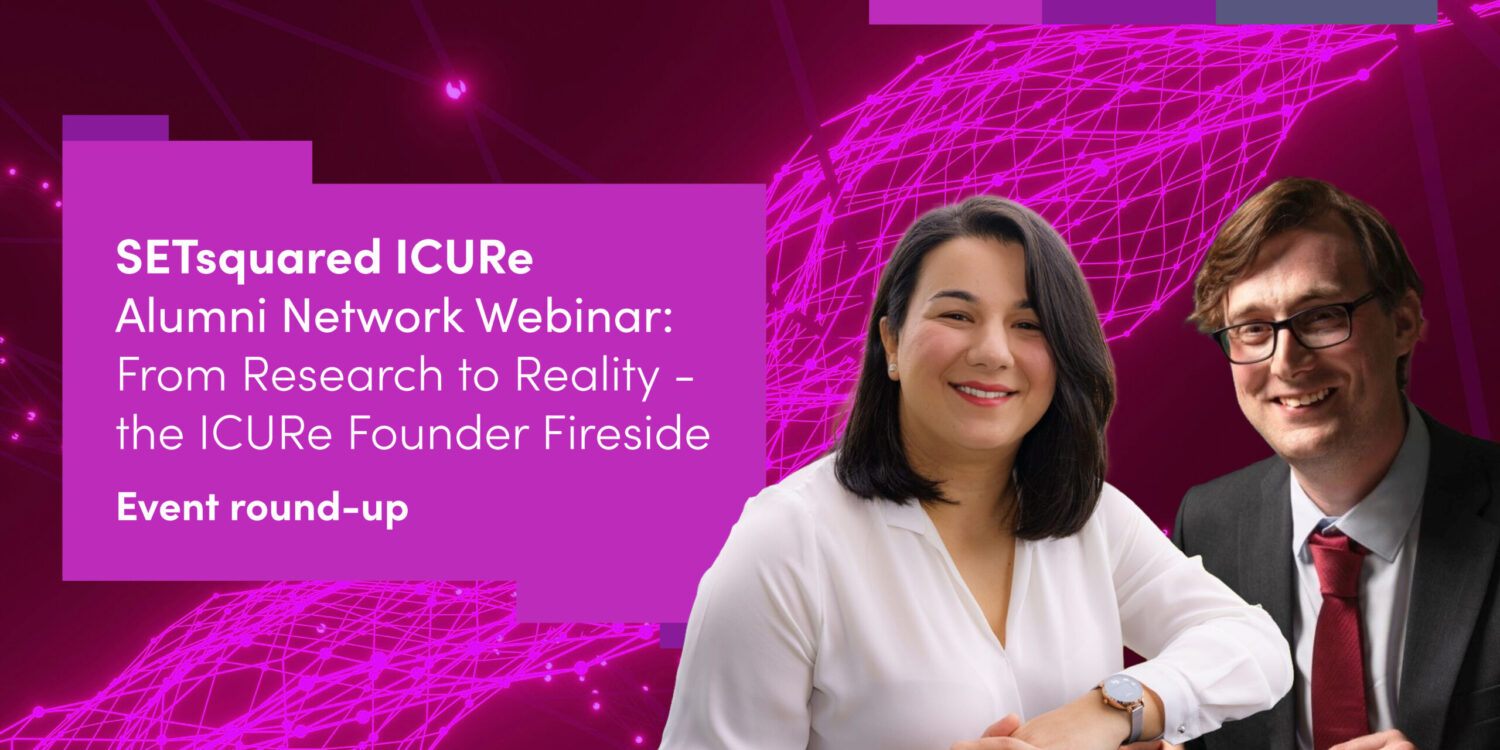
The SETsquared ICURe Alumni Network founder fireside brought together two experienced founders to discuss their journeys from academia to entrepreneurship, and what reality looks like beyond the breakthrough.
Dr Sam Moxon, Scientist Entrepreneur and Former CEO of Aegis FibreTech, and Pavlina Theodosiou, Co-founder and CEO of METzero Technologies, shared how ICURe supported their ambitions to spin out their research and what it’s really like to turn research into a business: finding out what customers need, bringing the right people on board, making tough calls and getting investors behind the idea.
Shifting your mindset and remaining open to change
For Pavlina, ICURe changed how she viewed both her research and her own potential as an entrepreneur. Although she had always had an entrepreneurial interest, she joined the programme with a predominantly academic mindset and little confidence that she could establish a deep tech clean technology company. The support of ICURe’s coaches, mentors and wider cohort helped her recognise that starting a business didn’t mean having everything figured out from the beginning.
As she explained, one of the biggest lessons was learning to be open about what she didn’t know and actively seek support to fill those gaps. “Be coachable and be honest with what you don’t know,” she advised, highlighting the importance of combining that willingness to learn with hard work. She also recalled how a presentation during the programme’s first day in Birmingham had predicted that participants’ lives would change. At the time, she was sceptical, but looking back, she recognised just how true that had become.
Sam experienced a similar shift, particularly in how he communicated his research. Before ICURe, his focus had been on an academic career, and his presentations naturally centred on scientific detail. The programme helped him translate those technical features into “actual sellable benefits”. This meant looking beyond what the technology could do and understanding the problems it could solve for potential customers, helping him recognise its value in a commercial setting.
The journey can also involve recognising where your own strengths lie. Sam realised that the part he had enjoyed most was getting a venture off the ground. As Aegis became more established, he recognised that taking a spin-out through to its seed round and leading it through the next stage would call for a different set of strengths: “I realise I’m more suited to building at the start, so that’s what I’ve been trying to focus my time on.”
Stepping back from your own venture doesn’t have to mean leaving entrepreneurship behind. It can open the door to new opportunities to focus on the work you enjoy most while helping other founders along the way. Sam left Aegis in June 2026 but remains involved as a shareholder. Today, he uses his experience to help other growing ventures take those first steps from spin-out to seed round.
Finding the opportunity and listening to the market
That shift in perspective became particularly important when the founders began testing their ideas with potential customers. Sam’s team at Aegis FibreTech initially explored dental applications before pivoting to another promising application in industrial heat shielding. Sam explained, “The market we spun out into is the one we had the least conversations in, but they were the most positive.” Although the team had held fewer conversations in the industrial heat market, the responses were considerably more positive, pointing to a quicker route to commercialisation and avoiding the lengthy clinical regulatory process associated with their original area of research. Those conversations ultimately helped shape their direction and demonstrated the importance of getting out of the lab and speaking directly to potential customers.
Pavlina’s experience reinforced the need to keep that customer focus beyond ICURe. She recognised that understanding the customer’s challenges was more important than becoming attached to the technology itself, explaining: “I fell in love with the problem the client has, not with the technology that I’m developing.” This realisation led to her rethinking how METzero Technologies approached its go-to-market strategy, commercial approach and product development. For both founders, market validation was not a one-off exercise, but an ongoing part of building a business.
Turning the opportunity into a business
The period following ICURe brought a different set of challenges for each founder, as they began putting what they had learned into practice and moving their businesses towards independence.
Sam balanced postdoctoral work with setting up Aegis FibreTech. The team secured an Innovate UK grant, worked with a manufacturing partner on feasibility and testing, and used university facilities while preparing to operate independently.
Pavlina balanced academic responsibilities with preparing to spin-out. After ICURe Exploit, she returned to a postdoctoral role and then took up a lectureship while continuing to validate the research and develop the business case. Innovate UK funding and an engineering enterprise fellowship helped her buy out her university contract and build the first minimum viable product.
She also highlighted regional innovation support. METzero Technologies brought in commercial expertise from the water sector, explored manufacturing relationships and used university laboratories and scientific expertise at a reduced rate. For Pavlina, these connections were not simply about finding immediate support, but about creating opportunities as the business developed. She encouraged other founders to put themselves out there, explaining: “The more you go to networking events, the more you are putting yourself out there, the more of these opportunities come and find you.”
The realities of building a company
Establishing a spin-out also means taking on responsibilities that sit well beyond the research itself. For Sam, one of the biggest lessons was the importance of having the right people around him. A small founding team can move quickly, but it can also leave the business exposed: “Looking back, I would have built a larger senior team earlier. With such a lean team, we didn’t have enough operational cover when things got busy.”
Navigating agreements with the university presented another challenge for both founders. Pavlina described the complexity of cap tables, share options and legal documentation, areas that were largely unfamiliar to her as a researcher. She also emphasised the need for founders to develop these skills: “Learning the skill and the art of negotiation is actually something that I would urge everybody to focus on developing.”
For Sam, negotiations centred on the university’s equity expectations and the terms governing how the company’s intellectual property could be used in a new application area. He highlighted the importance of looking beyond the percentage and considering what would give the business the best chance of success, noting that “you can have 30% of something that fails or 10% of something that’s going to do well.”
Learning to make decisions without all the answers
The pace of running a business also calls for a different approach to decision-making. Academic work often allows time to gather evidence and explore the details before choosing the next step. In a growing company, however, decisions cannot always wait for complete certainty. Pavlina explained, “You have to train yourself to take decisions with incomplete information.”
During the audience discussion, she shared how she sets herself an internal deadline before making the best-informed decision possible with the evidence available. Founders should not feel they need to have every answer, she added, reminding the audience that “you’re not the oracle in the business”. The important thing is to weigh up what is known, make a considered call and keep the business moving.
This mindset is also reflected in the culture being developed at METzero Technologies. The principle of “progress over perfection” sits alongside a focus on learning, accountability and assuming positive intent – recognising that moving forward and learning from decisions can be more valuable than waiting for everything to be perfectly clear.
Like Pavlina, Sam found that stepping into a new role meant accepting he wouldn’t have all the answers. Moving into aerospace meant letting go of the pressure to know it all. His starting point wasn’t mastering an entire industry but understanding his own technology and how it could solve customers’ problems. As he put it, “it’s okay for me to not know everything about this.”
Fundraising and building investor relationships
Sam’s seed round developed in part through a chance meeting at SETsquared’s annual investment showcase, after the team had built relationships with angel investors and industry partners. An introduction led to discussions with an investor connected to a company already helping to validate the technology. An early trial did not go as planned, but the team addressed the issue. Sam’s experience underlined the value of putting in the groundwork and being open to conversations. As Sam put it, “the harder you work, the luckier you get.”
Currently preparing a £1.5 million pre-seed round, Pavlina encouraged founders to start investor outreach early and take feedback seriously. Investors may identify issues founders have not considered, and responding constructively can strengthen the proposition. Sam added that founders should conduct due diligence on prospective investors, speaking to businesses they have backed. He also urged founders to be honest about drawbacks and consider what additional investment could make possible, not just the minimum required.
Stay connected with the ICURe Alumni Network
The experiences shared by Sam and Pavlina offered an honest picture of the opportunities and challenges that come with turning research into a business. Their journeys also showed that the transition does not end when a programme finishes; market discovery, learning and building relationships continue as a company develops.
The ICURe Alumni Network offers opportunities to stay connected, share experiences and support the next generation of researchers and founders. If you’re an ICURe alumnus interested in contributing to future activities, sharing your story or connecting with others, contact the SETsquared ICURe team.
Get all the fresh insights first! Stay up-to-date with all the
latest investment news, blogs and all things SETsquared.
Close
SETsquared is a partnership between



Close