SEARCH
Enter your search term below:
Close 
Enter your search term below:
WORLD LEADING BUSINESS SUPPORT
Facilitator:
Diana Galpin, Director of Enterprise & Knowledge Exchange, University of Southampton
Panellists:
Dr Catherine Headley, Chief Executive Officer, University of Manchester Innovation Factory
Nathan Guest, Corporate Partner, VWV
Sakura Holloway, Investment Director, Future Planet Capital
Elizabeth Yell, Legal Director, Osborne Clarke
To address many of the frictions that can slow progress, the Deal Readiness Toolkit (DRT), developed through the Research England-funded IMPACT-IP programme led by the SETsquared Partnership, was created to provide a common starting point for spin-out transactions. Through practical playbooks, standardised templates and guidance documents, the Toolkit aims to reduce unnecessary negotiation, improve transparency and help more companies become genuinely deal ready.
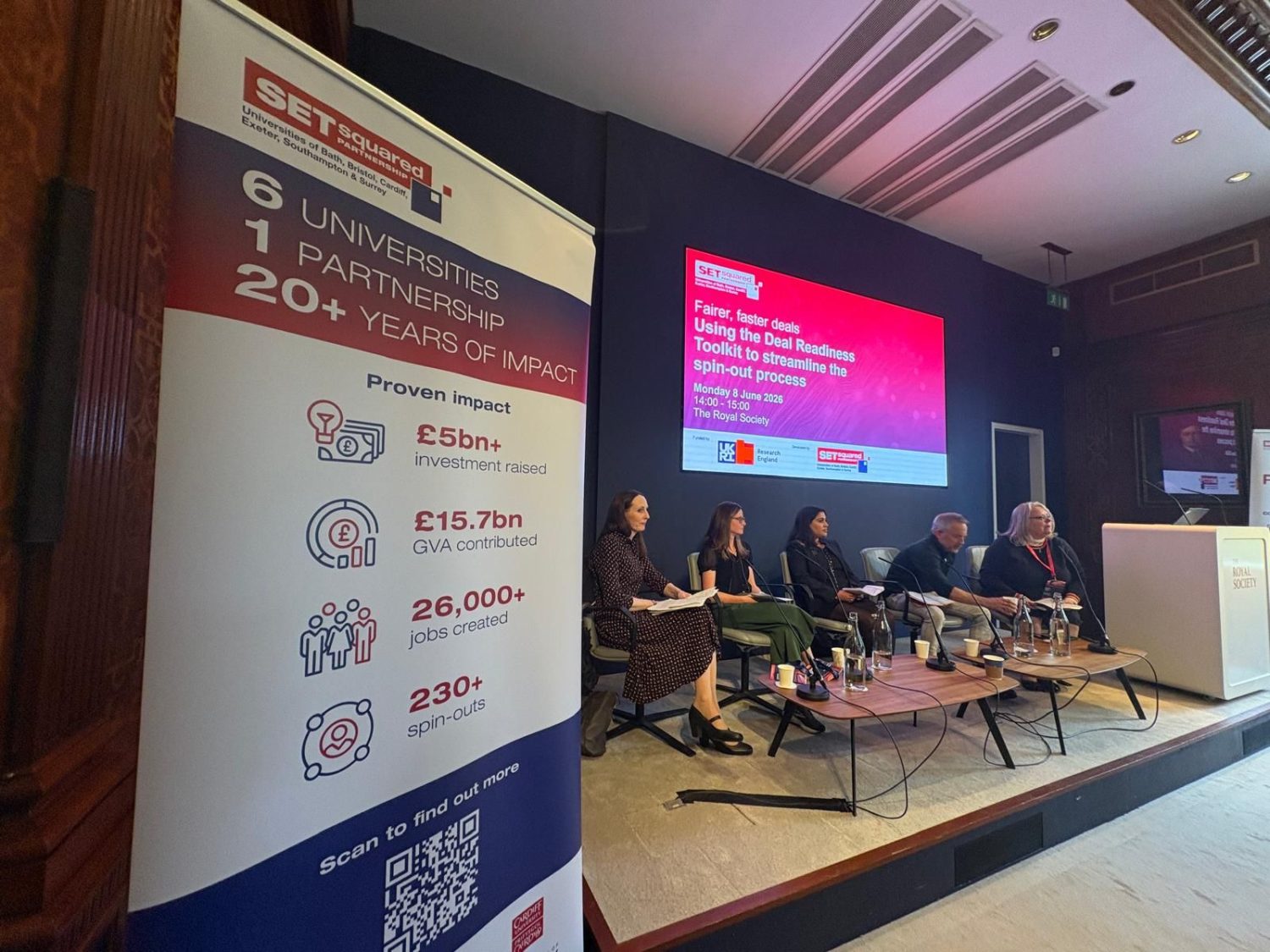
At the UK Global R&D and Science Investment Summit during London Tech Week, SETsquared brought together an expert panel representing investors, universities and legal advisers to explore how the Toolkit is already changing conversations across the ecosystem.
Facilitator Diana Galpin got the conversation started by explaining that everyone on the panel was a co-creator of the Deal Readiness Toolkit, as it was important for it to be built not just on the university voice. The first question she posed was “In your experience, what are a couple of key challenges in progressing to spin-out completion and closing the deal?”
ALIGNMENT BEGINS LONG BEFORE THE DOCUMENTS
One theme surfaced repeatedly throughout the discussion: alignment. Long before legal documents are drafted, successful spin-outs require founders, universities and investors to develop a shared understanding of both the opportunity and the journey ahead.
For Dr Catherine Headley, Chief Executive Officer of the University of Manchester Innovation Factory, many of the challenges arise because different stakeholders are approaching the same opportunity from very different perspectives.
“When you’ve got an academic founding team that has brought this technology on its journey over many years, if not decades, to the point of spin-out, it’s about aligning that with what an investor might be looking for, or what a market might be looking for from that technology. As our experience in Manchester shows, and as a lot of reports have documented, it isn’t necessarily a level playing field that we’re operating in. Different investors come along and the terms are not always what founders expect.
“When you look at resources like the Deal Readiness Toolkit, having investor endorsement and being able to say ‘this is a sector standard, this is what to expect’, really helps. It enables founders to look at things, analyse them and make good choices.”
Catherine argued that transparency and shared expectations are often more valuable than speed alone. By creating a common framework, founders can enter negotiations with a much clearer understanding of market norms, reducing uncertainty and helping discussions focus on value creation rather than process.
COMMERCIAL READINESS MATTERS AS MUCH AS TECHNICAL READINESS
While universities often focus on developing world-class technology, investors are ultimately investing in businesses. Sakura Holloway, Investment Director at Future Planet Capital, commented that this distinction remains one of the most important lessons for founders.
“We spend a lot of time talking about the plan. Founders will always come with a fabulous product development plan, but not necessarily a business development plan or a commercial development plan. We don’t want to know how you’re going to spend the money. We want to know what value you’re going to create in the business and how you’re going to de-risk it.
“Have you talked to customers? Have you had conversations with end users? Who actually has the problem you’re trying to solve? How are you going to sell this and how are you going to make money? Ultimately, all investors want to know is how you’re going to generate revenue and whether there is anyone in the real world who actually wants this product.”
“The science is going to work is not enough. That’s great, but it doesn’t mean the business is going to work. That differentiation is a really long and ongoing education process.”
Sakura also stressed the importance of alignment amongst investors themselves. Even when founders and universities are aligned, different investors may bring different objectives and expectations. Establishing clarity early can prevent difficult conversations later and ensure that everyone is working towards the same outcome.
THE LEARNING CURVE IS STEEPER THAN STEEP
For Nathan Guest, Corporate Partner at VWV, one of the most significant barriers facing spin-outs is simply that many founders are navigating the process for the first time.
“The reality of university spin-outs is that many founder teams are doing it for the first time and the learning curve is not steep, it’s steeper than steep.
“A lot of the real benefit of the Toolkit is actually the stuff that goes on before the documents are even produced. The work that’s gone into the playbooks helps founders understand that this is normal. It helps them get used to concepts that otherwise become very complicated when they’re at the coalface and the documents are actually being negotiated.”
Guest believes the educational value of the Toolkit is often underestimated. By introducing concepts such as governance, founder equity, investor protections and future funding requirements earlier in the process, founders can approach negotiations with greater confidence and realism.
He also highlighted the practical value of detailed term sheets.
“I’m a big fan of a very detailed term sheet. It’s worth investing the time because it makes life a lot easier later if you have that alignment. Once people understand the commercial position and expectations early, everything becomes much more efficient.”
IT’S NOT ABOUT CONFLICT, IT’S ABOUT UNDERSTANDING
From a legal perspective, Elizabeth Yell, Legal Director at Osborne Clarke, sees many transactions slowed not by disagreement, but by misunderstanding.
“Quite often, a lot of the task is taking different interested parties through the terms so that they all understand who’s coming from what perspective. What are the key deal terms? What are the standards? What is market practice?
“It’s not so much a misalignment issue. It’s more everybody being aware of what the other party means and what’s going to be non-negotiable, so that time is not wasted negotiating points that are already very market standard.”
Elizabeth also highlighted the importance of preparation and due diligence.
“Another part of transactions that we see slowing things down is around due diligence and making sure that the company has all its ducks in a row before it starts the process. Making sure the IP is in the right place, making sure the share capital is what everyone thinks it is, and that the right people have the right number of shares. Those things are absolutely crucial.”
By helping founders prepare documentation, structure data rooms and understand common investor requirements, the Toolkit can remove many of the avoidable delays that often emerge late in a transaction.
UNIVERSITIES ARE NOT ORDINARY SHAREHOLDERS
Diana posed the next question: “What makes university spin-outs fundamentally different from conventional start-ups?”
From Sakura Holloway’s perspective, one of the defining differences is the role of the academic founder and the challenge of balancing research commitments with commercial ambitions.
“Investors want to invest in people. When you’re writing that first cheque, you believe in the technology, but you also believe in the people who created it. One of the challenges with university spin-outs is that founders often have competing demands on their time. They have teaching obligations, students, research programmes and laboratories to run. So, there is always a conversation around how much time they can realistically commit to the company and how that aligns with the equity they hold.
“The other piece, and this is always slightly controversial, is the university equity position. A lot of what still happens, not just in the UK but globally, is that equity can sometimes be viewed as a reward for performance in the past rather than as an incentive for delivery in the future. Investors are always looking at whether the equity structure properly incentivises the people who are going to build and grow the business over the next five or ten years.”
Nathan Guest agreed that founder commitment and future incentives are critical considerations, but highlighted the additional complexity created by university-owned intellectual property and ongoing academic involvement.
“If you’re investing in a university spin-out, the IP position is almost always more complex than a conventional start-up. The university and academics may have spent many years developing that intellectual property and, in most cases, it’s being licensed rather than assigned into the company. Sometimes that IP has to be carefully partitioned because different spin-outs may be using the same underlying research in different fields or applications.
“You’ve also got academics who are remaining within the university while acting as consultants to the company. The university still needs access to that IP to continue its research obligations, so a lot of the work we do is making sure the investment agreements, the IP licence and the consultancy agreements all work together. If they’re not properly aligned, they can very easily clash.”
Elizabth Yell explained: “The university isn’t an entirely passive shareholder. It’s going to have key governance rights, policy constraints and reporting requirements. Investors sometimes need education around what the university’s requirements are going to be, because they may see those as constraints when actually they’re fundamental to how universities operate.”
Nathan Guest added that managing the relationship between the company, university and founders requires careful coordination.
“A lot of the time we are making sure that the investment agreements, the IP licence and the consultancy agreements all hang together. If those things are not properly considered and drafted, they will clash.”
Dr Catherine Headley continued: “I think one of the things that makes university spin-outs unique is that most academics didn’t set out to become entrepreneurs. They became academics because they were passionate about research, discovery and advancing knowledge. The opportunity to found a company often emerges much later in that journey.
“That creates a very different culture from many conventional start-ups. The motivations, expectations and experiences of academic founders are often quite different, which is why universities spend a significant amount of time helping researchers prepare for what lies ahead. For many, it’s an entirely new world, and supporting that transition from researcher to founder is a critical part of the spin-out journey.”
Diana Galpin: “What are the areas that founders most commonly underestimate or fail to fully appreciate at the outset of that journey? What are the expectations from investors and shareholders that often come as a surprise?”
Elizabeth Yell began the conversation on this one: “I think one of the areas founders often underestimate is the purpose of leaver provisions. These are the provisions that determine what happens to a founder’s equity if they leave the company. It’s understandable that founders can initially view them as punitive, but they’re actually designed to protect everyone involved.
“Investors are backing not just the technology, but the people behind it, and they want confidence that those individuals will remain committed to delivering the growth and milestones the investment is intended to support. Equally, leaver provisions protect founders themselves. If a co-founder leaves early, the remaining team generally doesn’t want that individual retaining a significant shareholding without continuing to contribute to the business. Ultimately, these provisions are a well-established market standard and play an important role in protecting the long-term value of the company.
“The other area that often surprises founders is dilution. Many founders understandably focus on the percentage of equity they hold at the point the company is formed, but they don’t always appreciate how that ownership will evolve through successive funding rounds. Concepts such as dilution and exit waterfalls can be unfamiliar, and it’s important for founders to understand how future investment will affect their shareholding and eventual returns.
“A big part of the process is helping founders understand that these mechanisms aren’t unusual or unfair; they’re standard features of venture-backed companies and are designed to align incentives, attract investment and support the company’s growth over the long term.”
Nathan Guest continued: “I completely agree with Elizabeth on the importance of leaver provisions. The key point for founders to understand is that these terms are normal. There are different ways to draft them, but the aim is to reach something that is broadly market standard, fair and reasonable for all parties.
“It is also important to recognise that, once investment has been raised, founders and management teams are operating with other people’s money. Even the lead VC is often a custodian of someone else’s capital, with their own reporting obligations, restrictions and duties to their investors. That means certain key decisions cannot simply be made unilaterally by the company.
“That can be a cultural shift for academic founders, particularly coming from an environment built around academic freedom. But after investment, decisions around major spending, hiring, salaries or potential exits often need appropriate oversight. The aim is not to slow the company down, but to create sensible thresholds that protect investors while still allowing the business to operate effectively.
“This is why education before the documents land on lawyers’ desks is so important. Founders need to understand not only what the terms say, but why they exist and how they support the long-term success of the company.”
STANDARDISATION CREATES TRUST
As the discussion turned to the Deal Readiness Toolkit itself, Diana asked the panellists how the resource is already influencing their transactions.
Nathan described using the documents across multiple spin-out transactions and becoming a strong advocate for their adoption.
“We’ve used them in anger. We’ve used them in venture capital investments, angel investments and spin-outs that didn’t have simultaneous investment. They work really well as templates and we’ve been recommending them to universities and investors outside the original programme.”
For Sakura Holloway, the Toolkit proved particularly valuable in a recent government spin-out transaction.
“It was great to be able to say, here’s a set of documents that investors have fed into, lawyers who work with universities have fed into, and universities have fed into. You can trust these tools.
“When we got to the documents, we were focusing on the really important parts rather than spending time debating every single clause. It meant we could maintain momentum and avoid deal fatigue.”
Catherine Headley reported that: “When I first shared the Toolkit with my team, the response was overwhelmingly positive. It’s since become part of our induction process for new colleagues, a valuable resource for founders preparing for their spin-out journey, and a practical tool we use in live transactions. For us, it provides a clear and trusted benchmark for what good looks like.”
BUILDING A NATIONAL STANDARD
Looking ahead, the conversation focused on adoption and the future evolution of the Toolkit.
Catherine Headley sees significant potential for the resource to become a recognised national standard.
“I would love to see this adopted nationally. We saw with the USIT guides the impact they had when they moved from a small group of universities to wider adoption. Deal terms are not always the same in different parts of the UK and having something that helps drive a more market-standard approach across the country would be amazing.”
The panel also discussed future opportunities including consultancy agreements, research collaboration templates, enhanced due diligence tools and additional sector-specific resources.
WHAT EMERGED FROM THIS DISCUSSION
What emerged from this discussion was a clear consensus: faster and fairer deals depend on much more than legal documentation.
Investors need confidence that founders understand their markets. Founders need clarity on what investors expect. Universities need frameworks that balance commercial agility with institutional responsibilities. Lawyers need common starting points that allow them to focus on strategic issues rather than repeatedly reinventing standard provisions.
The Deal Readiness Toolkit is helping to create that shared foundation. By bringing together investors, universities and advisers around a common framework, it is reducing friction, improving transparency and helping more high-potential spin-outs move from research discovery to commercial impact.
As adoption grows across the UK innovation ecosystem, the ambition is clear: faster deals, fairer outcomes and a more consistent pathway for turning world-class research into world-class companies.
Access the ToolkitGet all the fresh insights first! Stay up-to-date with all the
latest investment news, blogs and all things SETsquared.
Close
SETsquared is a partnership between


Close