SEARCH
Enter your search term below:
Close 
Enter your search term below:
WORLD LEADING BUSINESS SUPPORT
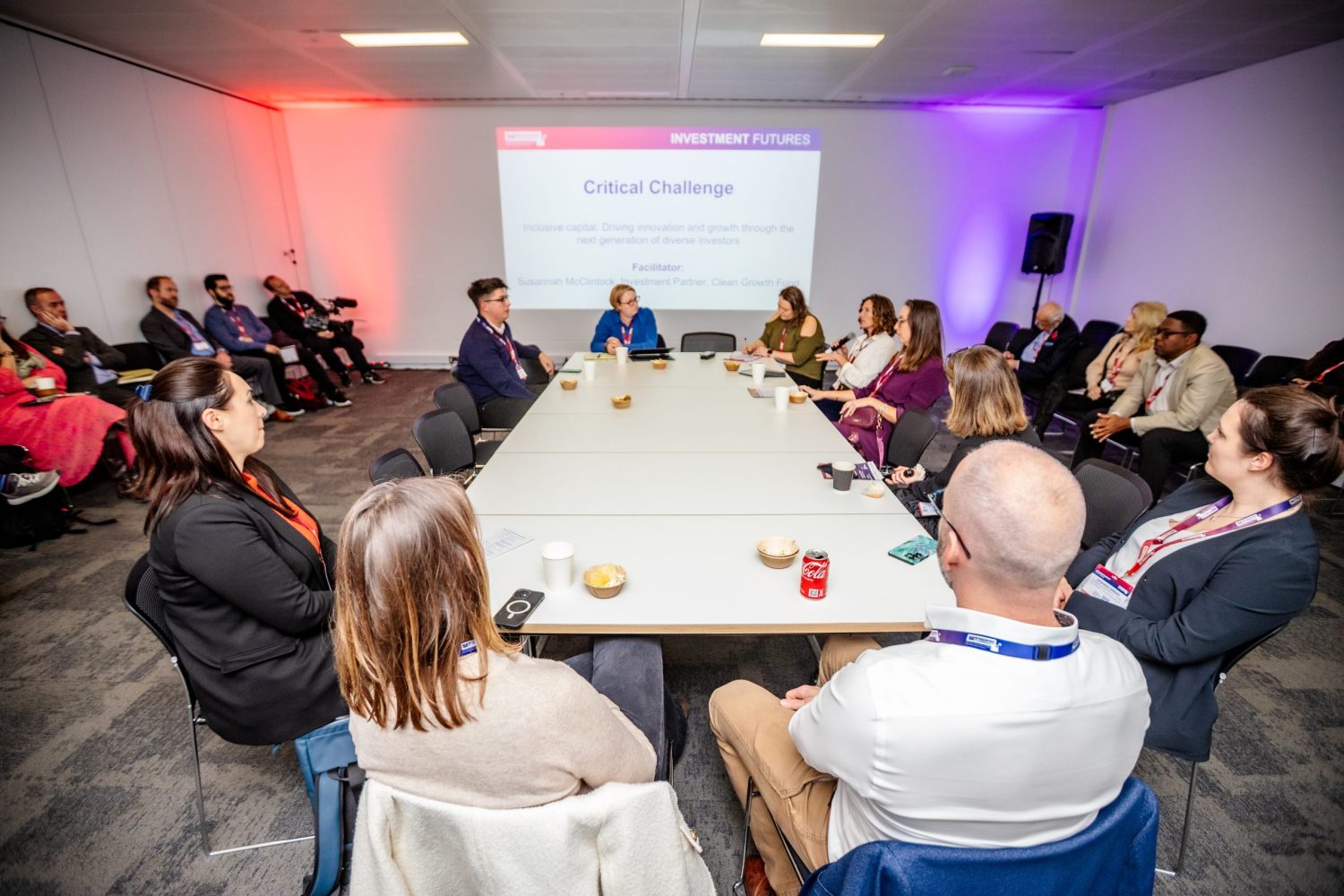
Ahead of Investment Futures, I visited a number of definitions of inclusive capital. The one that stayed with me was the idea that financial power should reflect and serve the full diversity of society.
We know that’s far from the case today. So, the real question is not whether inclusive capital matters, but where we can make tangible progress now and how we do it in a way that leads to better investment decisions.
One example is the Investing in Women Code, which has created a clear, measurable commitment to backing more female founders. With less than 2% of venture capital going to women-led businesses, that kind of focus is essential. We’re seeing funds make genuine efforts to shift the dial on gender representation, but there is still a long way to go, particularly when it comes to ethnicity, social mobility, educational access and the networks that shape who gets funded.
At Investment Futures, we heard strong evidence that diverse teams outperform. That insight is widely accepted, yet outcomes are changing slowly.
There are two structural reasons for that.
The first is the pipeline. From education through to entrepreneurship, the system still produces a relatively homogeneous group of founders. If the starting point is narrow, the pool of opportunities investors see will be too.
The second is who makes the decisions. Investment committees remain significantly less diverse than the society and markets they serve. If the lens through which opportunities are assessed doesn’t change, the outcome is unlikely to change either.
So, the challenge is twofold: broadening the funnel and diversifying the perspectives, making the calls.
Regional imbalance came up repeatedly in the roundtable discussion. For investors, the concentration of capital in a small number of locations is a missed opportunity.
The UK has outstanding universities, research centres and high-potential companies across the country. But accessing them requires intentionality – travelling, building relationships and becoming part of local ecosystems rather than expecting founders to come to you.
At the Clean Growth Fund, we operate a regional model, with each investor responsible for developing networks in specific parts of the UK. That means spending time on the ground, working with organisations such as SETsquared Partnership and the British Business Bank, and running regular roadshows to meet companies in their own environment.
For many founders, particularly technical or first-time founders, that approach makes the process more accessible and less intimidating, and it leads to better, more informed investment decisions.
Unconscious bias is difficult by definition – you can’t address what you can’t see. But you can design teams and processes that make challenge part of the culture.
A genuinely diverse investment team brings different regional perspectives, different professional backgrounds and different ways of assessing risk and potential. That diversity of thought is one of the most practical tools we have for improving outcomes.
Some firms are experimenting with blind screening at early stages, but ultimately, venture investing is about backing people. What matters most is creating an environment where assumptions are questioned and decisions are debated from multiple viewpoints.
For many founders, confidence, visibility and networks are as important as the strength of the proposition itself.
Capital rarely finds you – you have to put yourself forward. Regional ecosystems, cohort programmes and founder networks play a critical role in creating those pathways and in helping founders meet investors in a more supportive context.
Equally, investors need to be open to different founder profiles. In deep tech and engineering, for example, the most capable founders are not always the most polished presenters. The ability to look beyond delivery style and recognise underlying capability is essential for inclusive investing.
Quotas can be a contentious term, but targets matter.
Without clear ambitions, it is unrealistic to expect centuries of status quo to shift on their own. The success of the 30% Club in transforming gender representation on FTSE 100 boards shows what happens when an industry aligns around a shared goal. The results have now far exceeded the original target, currently at 45%, and continue to rise year on year, approaching near parity.
Targets are not just internal metrics – they send a signal to founders about who an investor is actively looking to back. They make the door visibly open.
When you look at the founders who successfully navigate the venture journey, the defining characteristics are often not the most obvious ones.
Resilience is critical. Fundraising is demanding, markets shift, and businesses have to adapt continuously. Alongside that sits adaptability – the ability to stay true to a mission while pivoting when conditions change.
These are difficult to quantify in a pitch process, but they are fundamental to long-term success.
For founders who feel the investment landscape was not designed with them in mind, there are reasons to be optimistic.
Mission-driven and impact funds are bringing new perspectives, new teams and a more representative decision-making environment. There is a genuine generational shift underway in parts of the market.
Venture capital will never be the right route for every business or every founder. But where it is the right fit, it can be transformative, and the range of people able to access it is broadening.
What came through most clearly at Investment Futures is that inclusive capital is not a standalone initiative. It is a way of making better investment decisions.
When investors widen their networks, diversify their teams, set clear intentions and meet founders where they are, they don’t just improve representation – they uncover stronger opportunities.
Inclusive capital, done well, is simply smart investing.
Download the Investment Futures reportsGet all the fresh insights first! Stay up-to-date with all the
latest investment news, blogs and all things SETsquared.
Close
SETsquared is a partnership between


Close