SEARCH
Enter your search term below:
Close 
Enter your search term below:
WORLD LEADING BUSINESS SUPPORT
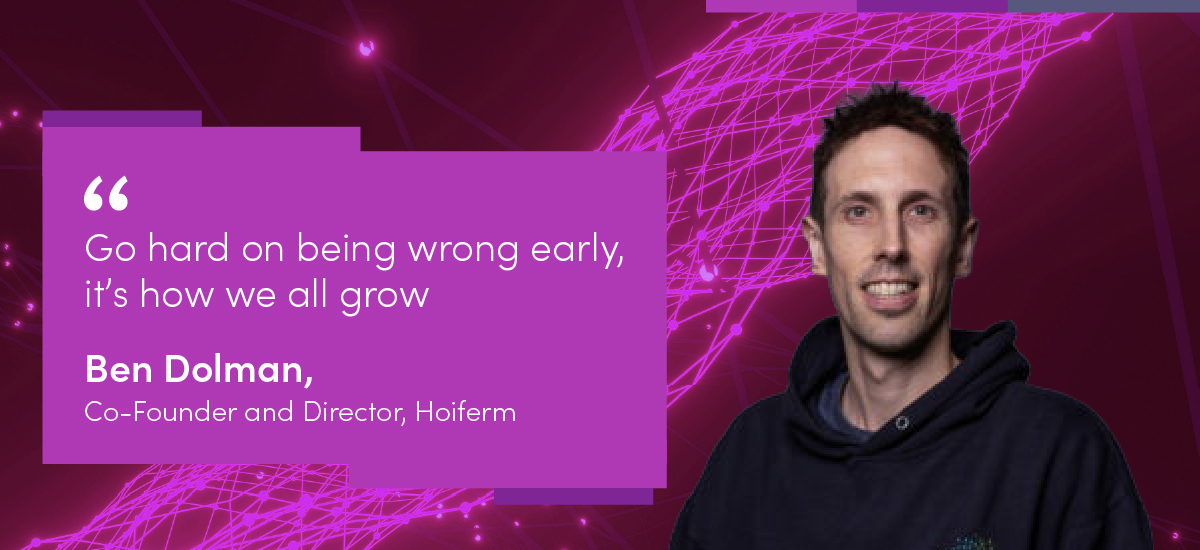
Meet Ben Dolman, Founder of Holiferm, a company developing sustainable surfactants designed to replace petrochemicals in everyday products like detergents and shampoos. Ben participated in SETsquared-delivered Innovate UK ICURe Explore in 2018, and Exploit the following year, and has grown from strength to strength ever since.
The early vision, and where it evolved.
Holiferm’s technology grew from a challenge stemming back to the 1960’s, when biosurfactants were first identified as a sustainable alternative to petrochemicals but were ultimately held back by cost. For decades, they remained technically viable but commercially uncompetitive, largely because the fermentation processes required to produce them were too expensive at scale.
At the outset, the commercial path seemed straightforward. I had planned to license Holiferm’s technology, allowing manufacturers to adopt a more sustainable process without having to change their operations. It was a model that looked efficient, scalable, and relatively low risk.
Innovate UK’s ICURe Explore and Exploit programmes provided a much need funding and commercial support. Rather than refining the plan in isolation, ICURe helped me to shift outward – towards customers, conversations, and real-world validation. I really appreciated the emphasis on customer engagement; it was so valuable to get Holiferm out in the open.
A huge turning point in this sense was meeting a potential licenser in Japan. The funding and business support from ICURe allowed me to travel out to Japan to conduct testing and receive critical market feedback. Engaging directly with potential partners began to surface a disconnect. The assumption had been that better performance, and lower cost would be enough to drive adoption. In practice, there was a substantial personal cost to implementing a new technology made externally, making companies hesitant to license in technology.
This experience, like many others I experienced when following a licensing path, led to a change of mindset, and a change to Holiferm’s approach.
Customers weren’t looking to license a process or integrate new technology into their systems. They wanted a finished ingredient, something they could use straight away without reworking their operations.
The pivot: licensing to manufacturing
Moving from a licensing to manufacturing was a major step-change. We had to build it ourselves, and this brought about challenges we hadn’t previously anticipated.
Rather than demonstrating capability at lab scale, we had to translate a working fermentation process into something that could run consistently, repeatedly, and economically at industrial volumes.
The commercial model had to be rebuilt around this new reality. Licensing had been simple in principle: transfer the technology and let others operate it. Manufacturing required a different mindset entirely. We were no longer selling potential; we were selling a finished product. That meant developing a value proposition rooted in performance, consistency, and supply security, not just cost or process advantage. It also meant taking ownership of customer outcomes in a way we hadn’t before, because we were now directly responsible for what ended up in their products.
Internally, this shift forced rapid growth. Skills that had previously sat outside the organisation – large-scale operations, process engineering, supply chain management – now had to be developed in-house. That wasn’t just about hiring; it was about learning how to operate as a production business while still staying close to the science that underpinned everything.
What made this shift possible was the willingness to move before everything felt fully ready. Scaling production, redefining the commercial model, and building internal capability all happened in parallel, not sequentially. It was demanding, but it also created momentum.
Where is Holiferm now, and is it going?
The focus has now shifted from proving the concept’s reliably at scale to rapid international scaling
We’re now producing at an industrial scale from our 1,500-tonne per annum facility, with products already moving into commercial supply chains and on shelves in major UK retailers. Biosurfactants are no longer seen as an interesting alternative; they’re being seen as the future.
Demand is growing quickly, and we’re expanding capacity to meet it. The challenge now is less about whether the product works, and more about how fast we can bolster capacity and build the required infrastructure to supply large volumes around the world.
What I’ve learnt, and my advice for the next founders
Having recently stepped into a non-executive role, I’ve created a bit more distance from the day-to-day pace. It’s given me space to reflect on the journey so far, but also to think more like an early-stage founder again, looking for the next problem rather than only executing on the current one.
In the same sense, I’m keen to give back to the next generation of founders. For early-stage entrepreneurs, so many of the critical decisions happen before there’s enough data to feel certain. The lessons I’ve learnt as a founder, and other founders alike, can guide and nurture the brilliant innovators coming through now.
One of the biggest lessons from my own journey is the importance of external input early on. I was already speaking to customers, but the structured engagement through programmes like ICURe Explore and Exploit pushed me to really understand how people perceive what you’re building. In our case, it became clear that customers weren’t interested in the technology itself; they were interested in the finished product. That kind of insight only really comes from getting out of your own assumptions and testing them in the real-world.
There’s also real value in seeking conversations and advice outside of your circle. We found that a lot of support exists informally: conversations, introductions, and honest feedback are there if you’re willing to look for it. Advice can be conflicting, but when you speak to enough people, patterns start to emerge that help you make better decisions for your specific situation.
A final piece of advice, and arguably the most important: go hard on being wrong early, it’s how we all grow.
A final thought
It’s easy to build a plan that makes complete sense in your own head. ICURe supported me to take it out into the world – and that made all the difference. The feedback wasn’t always what I expected, and some of it meant rethinking decisions I’d felt confident about. That’s exactly the point. Holiferm is where it is today because we were willing to test, adjust, and keep moving.
If you’re a founder sitting with a promising idea, get out there early, be ready to listen and adapt, and don’t be afraid to get it wrong. The path becomes clearer once you’re on it.
Get all the fresh insights first! Stay up-to-date with all the
latest investment news, blogs and all things SETsquared.
Close
SETsquared is a partnership between


Close