SEARCH
Enter your search term below:
Close 
Enter your search term below:
WORLD LEADING BUSINESS SUPPORT
Q: You’re the Innovation Lead at ICURe, but what brought you here? What’s your own connection to the world of research commercialisation?
My path into research commercialisation wasn’t planned, but looking back it feels like it was always heading this way.
I started in biochemistry because I was interested in how science connects to real-world problems. Even then, I was less drawn to theory and more curious about what happens when research leaves the lab and becomes something people use.
That curiosity led me into supporting early-stage companies, and later into founding a digital health venture, a diabetes app inspired by my sister’s experience with Type 1 diabetes. It came from seeing a gap and asking, quite simply, why isn’t this being solved?
I exited that company early, but it gave me a clear understanding of what research commercialisation needs: timing, support and structure. That is what pulled me deeper into this space and gave me a real appreciation of the impact research can have in society.
Q: Day to day, what does your role actually involve, and how does it sit within the broader ICURe ecosystem?
What stands out about ICURe is how connected it is. It works as part of a wider support system rather than a standalone programme, staying with ideas through exploration, validation and commercial readiness.
My role focuses on building that connectivity.
One part is investor engagement. We create warm spaces where teams can understand what investors are looking for and how they think, and where investors get to see emerging technologies earlier. That includes informal investor office hours, short sessions where teams can test their thinking and get feedback directly from investors.
These conversations help a team get from “we think this could work” to a clear sense of how they’d position it in a real commercial context.
Alongside this, we’re building clearer pathways across Innovate UK and UKRI programmes so teams can move more easily into follow-on support. The SETsquared ICURe Alumni Network is a positive step for those completing ICURe programmes, another layer of support as they take their next commercial steps.
Q: One of your roles is specifically about investor engagement, and Innovate UK have its Investor Partnership Programme. What could a pathway look like for an ICURe team that’s ready to raise?
At the point most ICURe teams reach investors, they’re still early-stage: capital-intensive and, on paper, risky. Investor conversations start to land when the technology is de-risked to a degree, but there’s still clear R&D ahead to drive the company’s growth. That’s often where blended public and private capital makes sense.
The Investor Partnerships programme supports this stage, helping structure investment so it reduces technical and commercial risk in parallel.
The strongest teams are deliberate about how they raise. They think beyond the capital itself, designing how grant and investment work together to reach the next inflexion point. The best cases are where a team uses non-dilutive grant funding to build the traction that attracts sufficient investment behind real company milestones.
Q: What advice would you give early-stage founders trying to get in front of investors?
The biggest shift is when founders start treating investors as partners in building the company. A good investor is more than a source of capital. They open doors to networks and commercial expertise. So be clear about what good looks like for you. Cheque size and sector fit matter, but so do the networks, experience and insight an investor brings, and those are what build real connections and better conversations with investors.
Clarity matters more than people expect. You may only have 30 to 60 seconds to explain your idea and your key messages, so it helps to have both a short and long version ready.
Strong founders don’t improvise these moments. They’ve thought carefully about what they need and how to explain it simply and clearly.
Q: Innovate UK, particularly through the ICURe programme, encourages applications from underrepresented groups in innovation. From what you’ve seen, are there still barriers, and what’s being done about them?
Some of my work focuses on female founders and female-led spin-outs. Progress is happening, but barriers remain. The Royal Academy of Engineering’s Spotlight on Spinouts 2026 report found that 17% of UK spin-outs founded since 2020 have at least one female founder, up from 7% in the 2010 to 2014 period, though it notes that progress has broadly stalled over the last five years.
What has changed is how coordinated the response now is. Within ICURe there are targeted cohorts and initiatives such as the ICURe Women Discover Programme. Others are widening access too, including Imperial’s WeInnovate, which has expanded nationally to bring in partner universities beyond London. More broadly, the Investing in Women Code and the British Business Bank are working to channel more capital to under-represented founders.
The difference now is coordinated action rather than acknowledgement alone.
Q: Not all the entrepreneurial leads that go through ICURe end up spinning out a company – what other paths have you seen people take?
One of the most important things to recognise is that a spin-out is only one of several valid outcomes, and not spinning out is not a failure. Innovate UK ICURe is built to test whether an idea has a genuine market, and part of what ICURe Discover and Explore do is help a team work out honestly whether their route is a spin-out, a licensing deal or more research. All three are legitimate outcomes.
Some people go back into academia with a much sharper sense of where their work could have commercial value, and that shapes the grants they pursue and the partners they bring in. Others find the strongest route is to license the technology to an established company that can take it to market faster than a young spin-out could. Re-Vana Therapeutics is the standout there, an ICURe team whose work led to a licensing deal with Boehringer Ingelheim worth up to £744m in milestone-driven payments. Adam Dundas at the University of Nottingham took a different route again, using his ICURe place to find industrial partners to develop Bactigon, his anti-biofilm coating, rather than forming a spin-out. And some move into consulting or advisory roles, or join another venture, where the commercial instincts they built on the programme carry across just as well.
What stays constant is the skill set. Learning to talk to customers, test assumptions and read a market does not expire if you decide not to incorporate. Across all paths, there’s a translation effect: people leave ICURe with a stronger sense of how ideas move beyond research, and they take that forward in whatever they do next.
Q: If an ICURe alumnus is reading this right now and wondering what they should do this week to move forward, what’s your single best piece of advice?
During ICURe, there’s structure and momentum. Afterwards, that stops, and you have to create it yourself.
My advice is to rebuild that structure deliberately: set milestones, stay close to mentors and alumni and be clear about what support you still need.
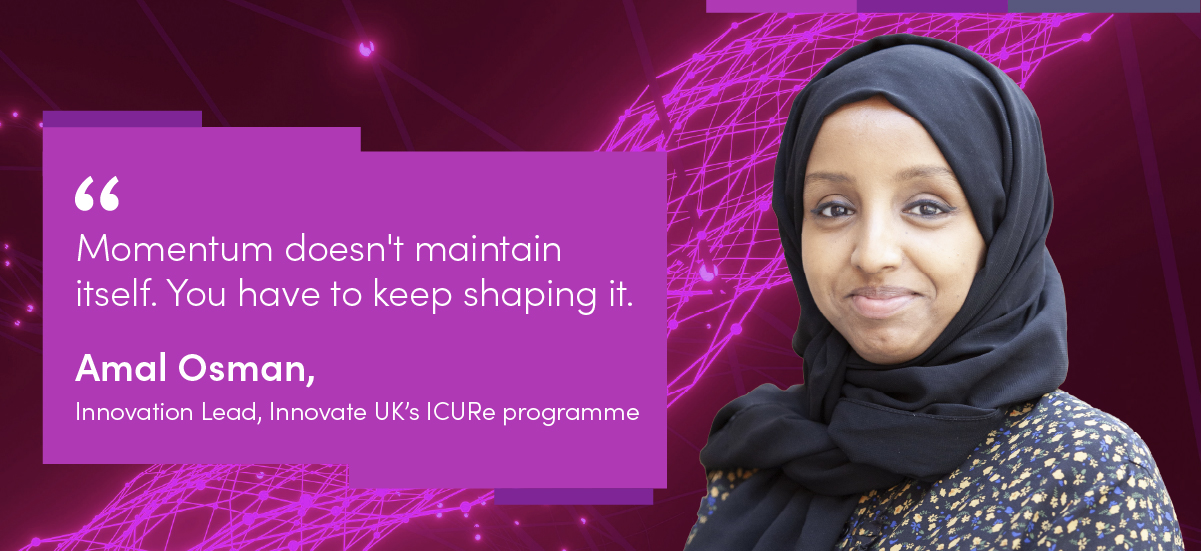
Stay active in the ecosystem you’ve built. Don’t step away too quickly and lose momentum. Momentum doesn’t maintain itself. You have to keep shaping it.
Q: What resources, communities or programmes would you point an ICURe graduate to if they want to keep building their commercial skills?
This is very timely, because there’s a single, curated place to start. Innovate UK ICURe is launching its Playbook in July, a signposting resource built for teams completing ICURe Exploit, and it gathers the organisations and opportunities worth knowing about in one place. Alongside that, keep an eye on the Innovate UK Business Connect website, which lists live funding and innovation opportunities as they open.
Two cross-cutting resources are worth bookmarking whatever your sector. SETsquared’s Deal Readiness Toolkit is free and Research England funded, and it’s a practical way to get your spin-out or licensing paperwork in order. Barclays Eagle Labs is a good route into networks, mentoring and investor connectivity if that’s the gap. After that, it comes down to where you are by stage, sector or region. In life sciences, Pioneer Group runs a 12-month Launch Programme that ICURe teams enter by invitation. For IP-rich engineering founders, the Royal Academy of Engineering Enterprise Hub offers Enterprise Fellowships. Bioscience and biotech teams should look at the BBSRC Research and Innovation Campuses and the Bio BIC incubator.
If you’re based in Scotland, Scottish Enterprise’s High Growth Spinout Programme is worth raising with your TTO, as that’s the route in. And for deep tech founders around Manchester, the University of Manchester’s Deep Tech Innovation Programme through Unit M is a three-month cohort with £25,000 of equity-free funding, lab space, mentors and an investor demo day. None of these is a recommendation; they’re starting points, and the right one depends on your technology and your plans.
Get all the fresh insights first! Stay up-to-date with all the
latest investment news, blogs and all things SETsquared.
Close
SETsquared is a partnership between



Close