SEARCH
Enter your search term below:
Close 
Enter your search term below:
WORLD LEADING BUSINESS SUPPORT
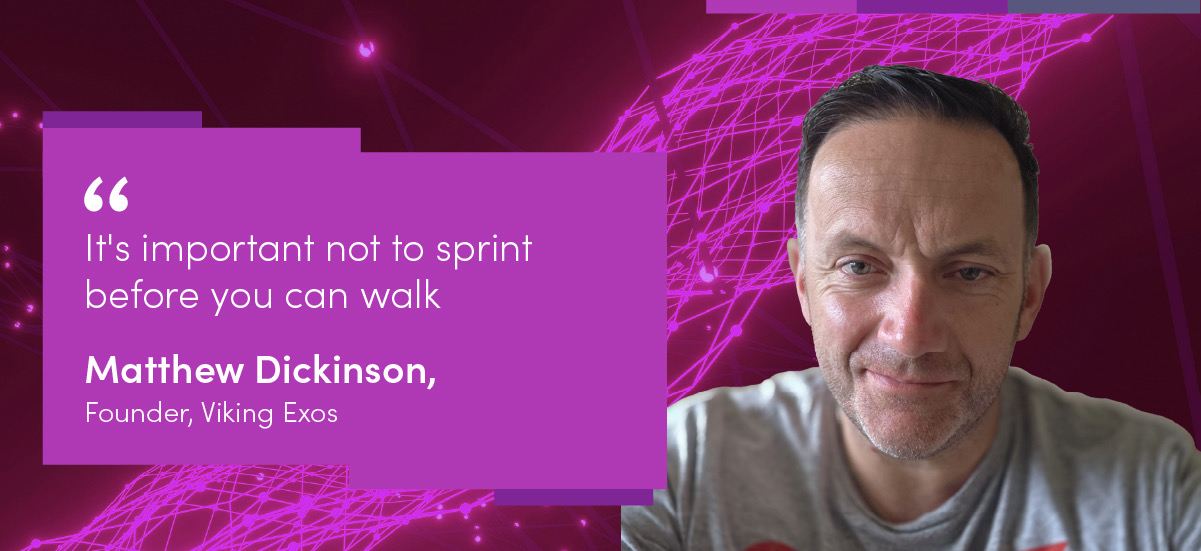
What does it take to transform a research idea into a business capable of making an impact on a global scale? For Matthew Dickinson, founder of Viking Exos, the answer has involved much more than technical expertise. It has required resilience, adaptability, and a willingness to challenge assumptions along the way.
Since then, Matthew has progressed through the Innovate UK ICURe pathway, participating in Explore, Discover, and Exploit which were delivered by SETsquared, built relationships with government and industry stakeholders, navigated intellectual property challenges, and established Viking Exos as an independent company with an international outlook.
Matthew reflects on the experiences that shaped his entrepreneurial journey, the lessons learned from building a company, and his vision for the future of Viking Exos and its exoskeleton technology.
The origins of Viking Exos
The inspiration behind Viking Exos came from an unexpected place. At the time, I was involved in a Primary Engineer competition that attracted entries from around 37,000 young people. One submission stood out. A young girl wrote about her cousin who had Spinal Muscular Atrophy, a rare genetic disease that causes progressive weakness in the spinal cord, noting the lack of exoskeleton solutions available for children. It was one of those moments that makes you stop and think.
As an engineer, you’re hard-wired to identify problems and find solutions. The more I explored the space, the more I realised there was an opportunity to create technology that could genuinely improve people’s lives, for all ages and abilities. It was a harsh reality, but real light bulb moment. That became the starting point for Viking Exos.
The company name itself reflects part of my motivation. There’s often a perception that innovation happens elsewhere and that the north of the UK plays a supporting role. It’s something I’ve noticed throughout my time in academia and in industry – it really drives me to keep innovating and show what us northerners can really do. I’m also fascinated by my heritage and family history. When I began researching my ancestry, I discovered that Viking roots run deep throughout my family tree, making the name Viking Exos feel particularly fitting – honouring my heritage of innovation and celebrating the creativity, engineering talent and manufacturing capability that exists across the region.
From academia to Industry
Having spent over 15 years in academia, my background predominantly lies in mechatronics, basically “hardcore physics”. Before launching Viking Exos, I completed a PhD in Tribology (mechanical engineering). During this time, I was able to work on Formula 1 projects with the Mercedes-Benz AMG Petronas Formula One team, analysing the compatibility of piston rings in race applications. The work was technically demanding and incredibly rewarding, but not really what I was looking for.
Ultimately, I wanted to look under the bonnet and move beyond academia. The work I was doing had real potential, and I needed to step away from academia into industry. Academia has formed the foundations of where I am today, but it’s missing a link to the real-world. That’s where Innovate UK’s ICURe programme came in – it was that missing link I was looking for.
How ICURe changed my perspective
When I first joined ICURe, I wasn’t entirely sure what to expect. I began my ICURe journey with Discover out of pure curiosity; I have an idea, let’s see what I can do.
Stepping into an ICURe environment felt daunting at first. I felt a bit of imposter syndrome working alongside individuals from Cambridge, Imperial College, and other prestigious institutions and experienced academics. Despite this feeling, I knew I was meant to be there, and I quickly found that my initial apprehension was unfounded.
The support and encouragement from the facilitators and my peers were second to none. The opportunity to network and grow alongside talented individuals helped grow Viking Exos and my own abilities massively. What I learned was that successful entrepreneurship isn’t about where you studied. It’s about understanding a problem, building a solution and being willing to learn. The programme brought together people from different backgrounds who were all trying to solve meaningful challenges.
One of the biggest benefits was the exposure to a completely different way of thinking. It really opened my eyes to the cogs of the machine; where I was only seeing the technical side, previously, ICURe encouraged me to think about customers, markets, communication and strategy. I was now becoming aware of the commercial potential of Viking Exos.
Building a business forces you to look beyond the engineering. You need to understand how people make decisions, how markets operate and how organisations adopt new technology. Through ICURe, I was introduced to conversations and opportunities that I would never have encountered in academia alone.
Navigating the highs and lows of entrepreneurship
As a researcher, it’s easy to become focused on the technical challenge in front of you, but ICURe encouraged me to engage with people from government, industry, defence and the wider innovation ecosystem. Those conversations helped me develop the confidence to talk about our technology, articulate our vision and understand the commercial realities of bringing a product to market.
Since completing ICURe, networking has taken Viking Exos from strength to strength. I have been able to engage with stakeholders from government, defence and industry, including connections that led to discussions with the Ministry of Defence and even participation in NATO meetings. Most importantly, those interactions challenged my assumptions and broadened my perspective on what it takes to build a successful business. They helped me appreciate the value of other disciplines that would inevitably play a role in the direction of Viking Exos – marketing, communications and business development are all vital components of a successful business alongside engineering and other technical disciplines.
The relationships formed through networking continue to influence the direction of Viking Exos today. They have opened doors to new markets, informed our strategic decisions, and supported our transition from a university-led project into an independent company operating internationally.
The biggest challenge: rebuilding from scratch.
Like many start-up journeys, mine hasn’t been straightforward. One of the most difficult periods came when we transitioned away from our university affiliation. We were unable to reach an agreement around licensing the original intellectual property, which meant we had to return that work and start again.
On paper, that may sound straightforward. In reality, it was one of the most stressful decisions I’ve had to make. Walking away from years of effort is never easy. However, it also gave us an opportunity to build something that was entirely our own.
We developed new intellectual property, established a clearer vision and created a company structure that aligned with our long-term goals. Looking back, it was a difficult process, but it strengthened the business and reinforced the importance of maintaining control over the direction we wanted to take.
Where Viking Exos is today
Today, Viking Exos operates with a strong focus on safety standards, customer confidence, and accessibility.
A significant part of that work has involved spending time in Philadelphia, where I work closely with international standards development organisations helping to shape frameworks for safety and regulation. For emerging technologies such as exoskeletons, safety and regulation are not secondary considerations; they are fundamental to long-term adoption.
Working directly with the organisations setting international standards means we’re not playing catch-up later or retrofitting ideas into products that are already half-built. Instead, we’re in the room early, hearing how expectations around safety, usability and performance are shifting across different markets and folding that thinking straight into the design process.
It also gives us an early signal on where things are heading – the subtle changes in language, priorities, and technical requirements that usually only become obvious once they’ve already landed. Rather than reacting to that wave after it breaks, Viking Exos is helping shape the direction it’s coming from.
For a UK company operating at this level in exoskeleton technology, that position matters. It keeps us close to the people defining what “good” looks like next, and it strengthens our ambition to see the UK playing a more visible, confident role in this emerging space.
Another lesson I’ve learned is the importance of direction.
Initially, we explored opportunities within defence and military markets. While those conversations were valuable, we found that requirements could be difficult to define and priorities often shifted. Over time, it became clear that a more focused approach would allow us to build stronger foundations.
Now, we’re concentrating on business-to-business and consumer applications. We’re developing the Nest exoskeleton built for flight and taking a deliberately measured approach to growth. Rather than chasing complexity, we’re focused on creating solutions that are practical, effective and safe
There can be a temptation in technology start-ups to move as quickly as possible. My view is that it’s important not to sprint before you can walk. Sustainable progress often comes from getting the fundamentals right. From your starting point to your end goal, the opportunities are endless; don’t rush to the finish line.
Looking to the future
The future of exoskeleton technology is incredibly exciting. We see opportunities across a range of sectors, particularly in areas such as hiking, outdoor recreation and search-and-rescue operations.
Healthcare also presents significant long-term potential. However, I believe it’s important to approach that opportunity responsibly. Technologies designed to support people with complex neurological conditions require extensive validation, testing and evidence. We need to ensure that products are genuinely safe and effective before they reach those users.
Reflecting on my journey, ICURe was much more than a programme. It provided a platform that challenged my assumptions and helped me refine both the mission and the vision behind Viking Exos. Most importantly, it demonstrated that entrepreneurship is a skill that can be learned.
For me, success isn’t just about developing new technology. It’s about creating solutions that people trust and that deliver meaningful benefits in the real world.
Get all the fresh insights first! Stay up-to-date with all the
latest investment news, blogs and all things SETsquared.
Close
SETsquared is a partnership between


Close